CHARACTER PROFILE
Under the Moon
- Primary work
- Thus Spoke Kishibe Rohan
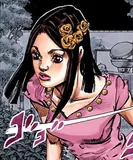
Under the Moon (月下, Gekka) is the main antagonist of Rohan au Louvre. It is a painting created by the Japanese artist Nizaemon Yamamura around the 17th century. It depicts a portrait of the late Nizaemon's wife, Nanase Kishibe, made entirely out of the blackest and purest ink in the world, taken from the pigment of an ancient tree's trunk.
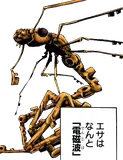
The pigment that Nizaemon extracted from the 2000-year-old tree came from a substance drawn from insects living in the very core of the trunk. These infinitely black creatures, resembling spiders, were hidden in the darkness since the dawn of time and are now bound to the painting. Thus, the painting is actually "alive", attacking whoever approaches it in response to Nizaemon's hatred.
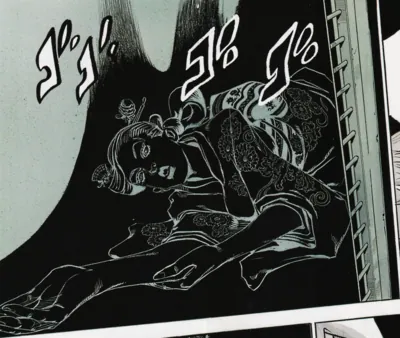
Image attribution details
Under the Moon. Source illustration via JoJoWiki; copyright remains with the original rights holders.
Image via JoJoWiki. Original franchise/production rights holders retain copyright; the wiki text CC BY-SA license does not license this image.
Original image ↗ · Archived image ↗01Basic information
02Appearance
Under the Moon is usually seen in the form of a black painting portraying Nanase Kishibe in white ink on a black background. She is wearing a kimono and lying on her side with her mouth open. Her left hand holds her elbow while her right hand is stretched out with her palm open, as if she is reaching out of the painting. On occasion, the painting will "scatter", revealing its true form as a group of pitch-black insects resembling spiders.↗
In the movie adaptation, the painting is a portrait of Nanase who is standing upright and staring at the viewer, with her hair flowing in all directions.↗
03Abilities
Cursed Painting
The particular pigment that Nizaemon used for his canvases caused his hatred to forever be locked into the paintings. Cursed by his hatred mixing with the substance from the insect creatures, Under the Moon can detect any nearby lifeform who approaches it by sensing their heat or breathing.↗
For example, if someone touches a person who drowned, their body will also experience drowning even if there is no water around them.↗↗
The painting first targets an individual based on their own sins. However, if they have not committed any sins or are unaware of it, then they will instead be attacked by the regret, resentment, and sins of their ancestors.↗↗
04Story
SPOILERS
Around the 1700s, Nizaemon discovers a deep black pigment within an ancient tree and cuts down the tree to obtain it, unaware that it is forbidden by decree to do so. As punishment, Nizaemon is executed just after his wedding with Nanase. Having been forced to become a widow, Nanase becomes gravely ill and dies soon after. The hate in Nizaemon's heart for meeting such a fate is transferred and sealed in the painting, giving it life and a murderous intent.↗
Although all of Nizaemon's works were burned after rumors of them being cursed, he managed to hide Under the Moon in a safe location before his death. A landowner in Nanase's hometown finds the painting in the back of his barn, and then a curator from the Louvre takes it to the museum in 1989. The curator ends up being killed by the painting.↗
The painting does not go on display in the museum and is instead hidden within Warehouse Z-13, part of the far eastern section in the Asian Art department of the Louvre. Gaucher reveals that Warehouse Z-13 has actually been closed off and abandoned since 1976. Curious about what lies there, Gaucher, Noguchi and two firefighters decide to go investigate the area with Rohan. As soon as they approach the painting, everyone accompanying Rohan dies from the painting's curse.↗
After a thorough, scientific examination of the painting by experts following the disappearance of staffers who approached it, it is rumored to have been burned. However, Rohan cannot confirm whether this is true.↗↗
Film History
In the movie adaptation, it was Nanase who, 250 years ago, discovered that a pitch black sap was oozing out of a sacred tree in a shrine.↗
At the time, Nizaemon Yamamura was cast out of his clan for painting art influenced by foreign trends. When Nanase fell ill, Nizaemon didn't have the money to cure her and thus he begged his father for help, asking to return to the rich Yamamura clan. His father agreed on the condition that he painted something better than the father ever did and so Nizaemon strove to make the greatest painting.↗
The painting seemingly killed people over the years but remained in the possession of the Kishibe family, from which Nanase came from.↗
When Rohan was just a young aspiring artist, he moved into his grandmother Yu 's inn, in which the painting was stored. Yu had decided to sell all but the necessities of the house following the passing of her husband, including the painting, which was sold to Gaucher Bigotte, curator of the Louvre, through an antiquarian named Yoshio Kawadori. The painting killed Kawadori, but Gaucher nonetheless came to inn to take the painting himself.↗
In the Louvre, the painting was stored in Warehouse Z-13 beneath the museum. While the warehouse was emptied and the the art stored within moved to a more secure location, the black painting was forgotten inside. The warehouse was also used discreetly as part of an art forgery operation in 2023. However, the painter and art forger Maurice Legrand 's guilt allowed the painting to drive Legrand mad. Legrand created a painting called "Noire" which had the same properties as the black painting.↗
It is subsequently burned away, by a fire caused by one of the spectres who died in a fire and burned Hugo Renard, the fire spreading through the web created by the spiders of the painting.↗
05Plot details
SPOILERS
Abilities / Cursed Painting
It then attacks them through their memories and genetic memories, conjuring their ancestors or other deceased individuals from their memories as ghost-like creatures to attack the victim.↗
If the victim touches the ghost, they will experience the same death as whoever they touched.↗↗
06Sources & attribution
- Under the Moon
Source text: JoJoWiki and its contributors. This entry has been reorganized and condensed for readability under CC BY-SA 4.0. Archived records reflect their capture dates. Referenced manga, anime, and artwork retain their respective copyrights.
07More profiles to explore
Continue with related characters, distinct versions and more profiles from the same recorded work.